
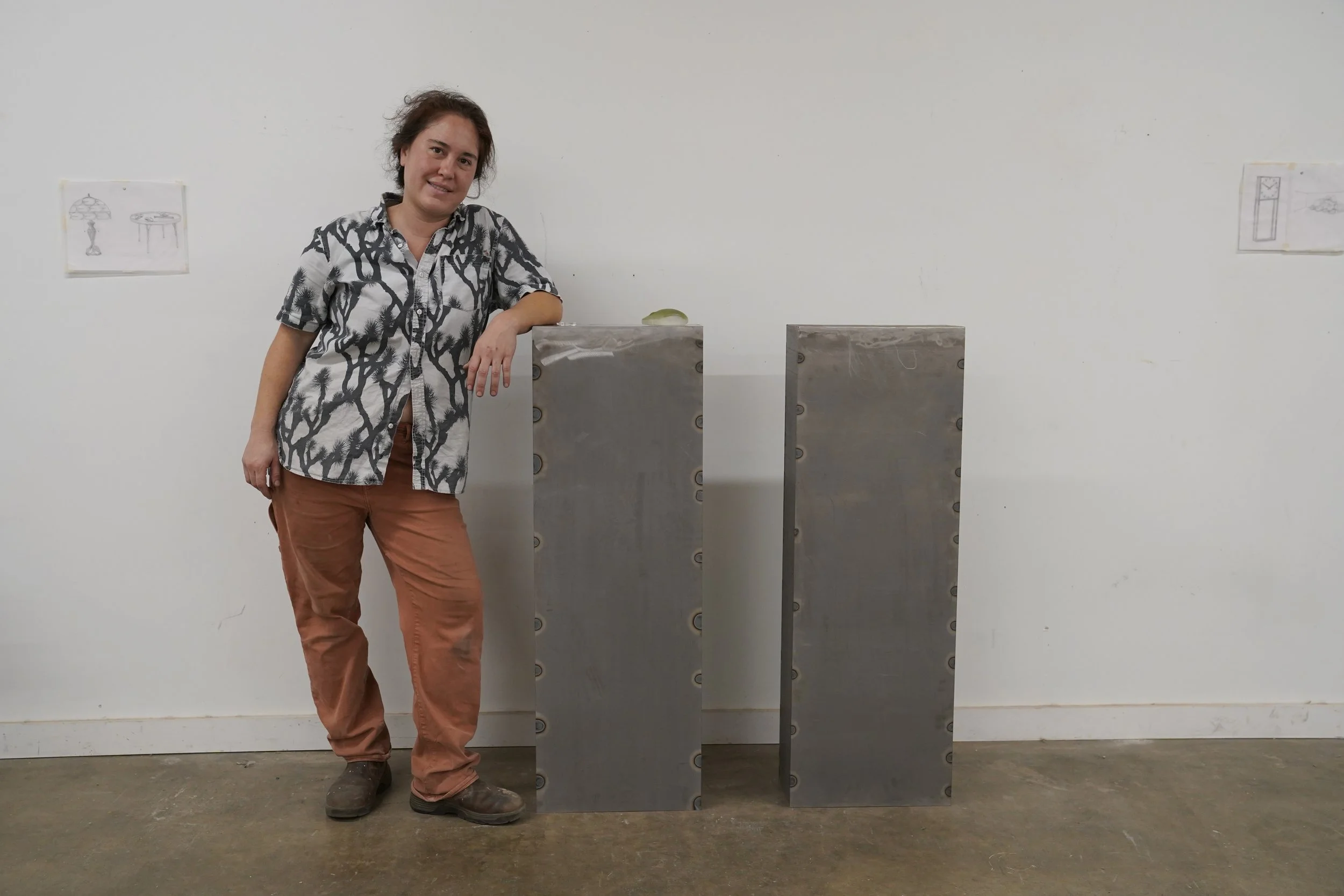
Katie Chin in the workshop at Stove Works.
Before we begin our conversation, it is important to situate the work of Katie Chin, a New York-based artist whose sculpture and installation practice explores how individuals can shape and challenge social systems. Working with a variety of materials along with found objects, Chin transforms familiar tools and infrastructure into sculptures that explore themes of labor, collective action, resistance, and agency. Through her research into stigmergy, sabotage, and the power of small interventions, her work asks how individual gestures can accumulate into broader structural change and social imagination.
Nik Hudson: I'm Nik. What's your name?
Katie Chin: My name is Katie. Nice to meet you.
NH: So, you mentioned that, I think the first time we met, that you were from New York. Are you from there?
KC: I'm originally from Ohio. New York, I guess, in 2020.
NH: What made you decide to apply to Stove Works specifically?
KC: So I've had a few friends go through the residency before. I'm actually staying in one of my friends' rooms. Her name is on the wall too. Cool. Leandra, I think, who’s on the board, Stove Works artist and mentor of mind. She recommended I apply.
NH: Yeah, I just wanted to because, I don't know, I wonder, “How do these people just find this place?” Like, I think Stove is a very cool place, and I'm not really from Chattanooga, and when I found this place, I was like, “This is awesome!”
KC: I applied to, you know, a handful of residencies, but with the application for Stove Works it was really unique in that they asked a question about an Anthony Huberman article about how people listen or be present with the world. It was really refreshing.
NH: I had to answer that too, when I was applying for my internship. I was interested in these values, and I can see that reflected in the people that work here too! Anyways, I’m curious; me personally, I'm a painter, and I was going to ask what draws you into sculpture and what materials you're most fond of. I mean, I can kind of see that right now as we're sitting in front of your work, but I’d love to hear more.
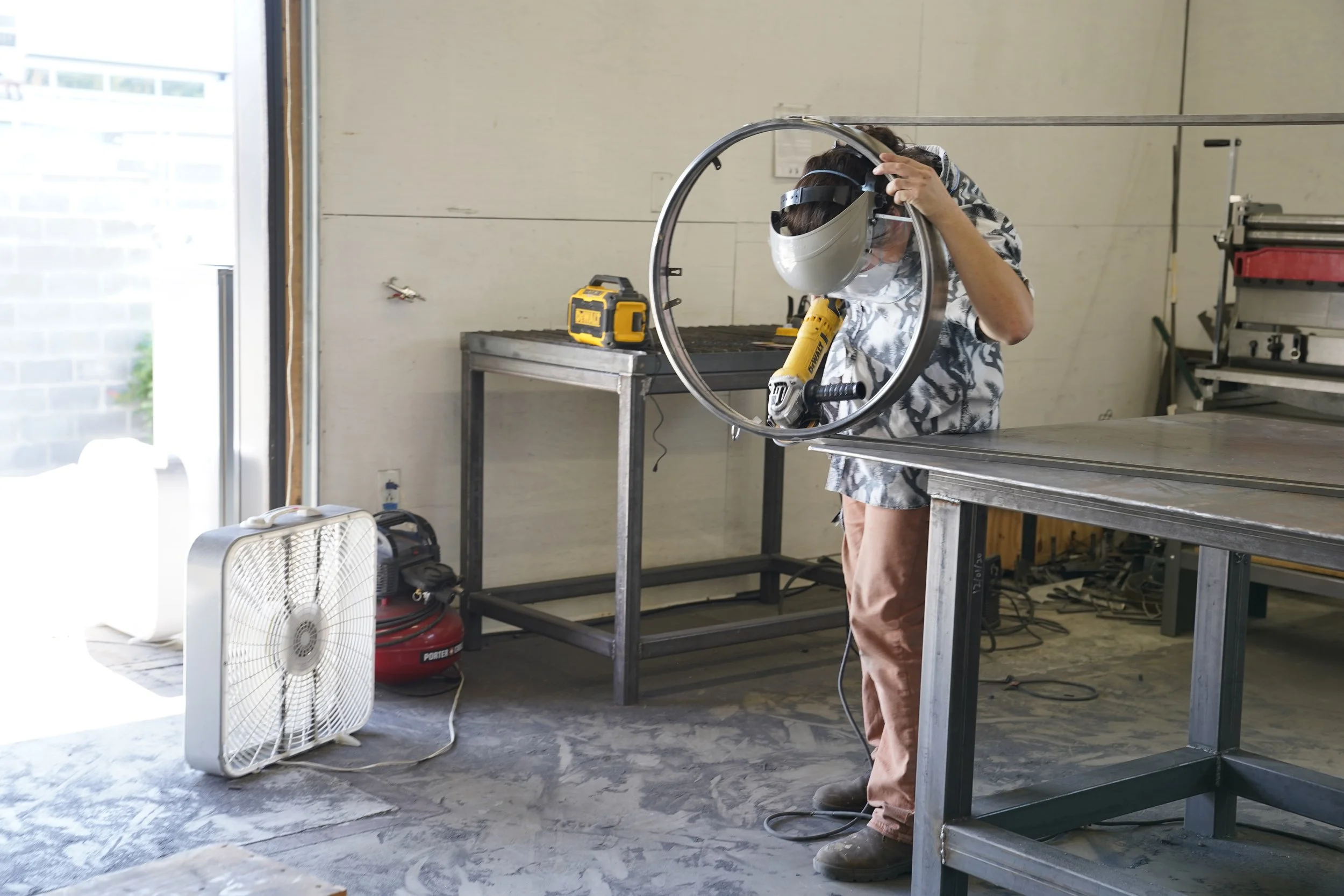
KC: So, actually, I started as a painter, and then I moved into performance art before grad school. My grad school portfolio was mostly performance-based. And then, I was supposed to start grad school in the middle of COVID, and I was like, uh, that's art school online… let's not do that. I ended up deferring, and in that deferral year I started playing with clay, really for the first time, and I fell absolutely in love with ceramics. With painting, I was always looking at the sides of paintings, rather than front on. So I feel like the depth and the layers- I was really attracted to, like, trying to understand how something was made—not just the image. So, I feel like with sculpture, you get more of that depth and object-ness of things. But then with it also, I feel like ceramics especially mixes my experience doing more performance where your body's very much involved with the process. But I was kind of tired of, like, my physical likeness having to be on display. Ceramics is still very bodily. You're lifting 50-pound bags of clay around, and you're pushing clay through your hands; it's such a bodily process to make something.
NH: You can have the object live on its own and outside of you.
KC: And then what you're seeing here is a lot of metal and glass, sort of like ceramics, is where I started with sculpture, but I've been expanding that vocabulary into other materials too, but I think the through line between all of these things, whether it be ceramics or metal or glass, there's some sort of like transformation that happens with the material that goes through some sort of process. And I like that because it aligns also with the concepts I'm dealing with, because I'm thinking about how social change happens, sort of about the like, like, I'm thinking of, like, how small changes push up against big systems. But I was talking to someone the other day, and they're like, "Oh, it's almost like this atomic scale that you're interested in, but then how that blows, how that, like, has a ripple effect until, like, like a tidal wave, you know? So I think a lot about the relationship between individual agency and collectivity. But with these materials, it's like, there are these small atomic changes that are happening. This fiery kiln changes raw earth into, like, this strong yet fragile, like hardness. I’ve also recently joined the board of Queer Atmosphere, which is the Atmospheric firing.
NH: Yeah, you're talking about atmospheric firing. That's like a very community-based process, right? Like you have to have a lot of people? Where do you think community lies in your work?
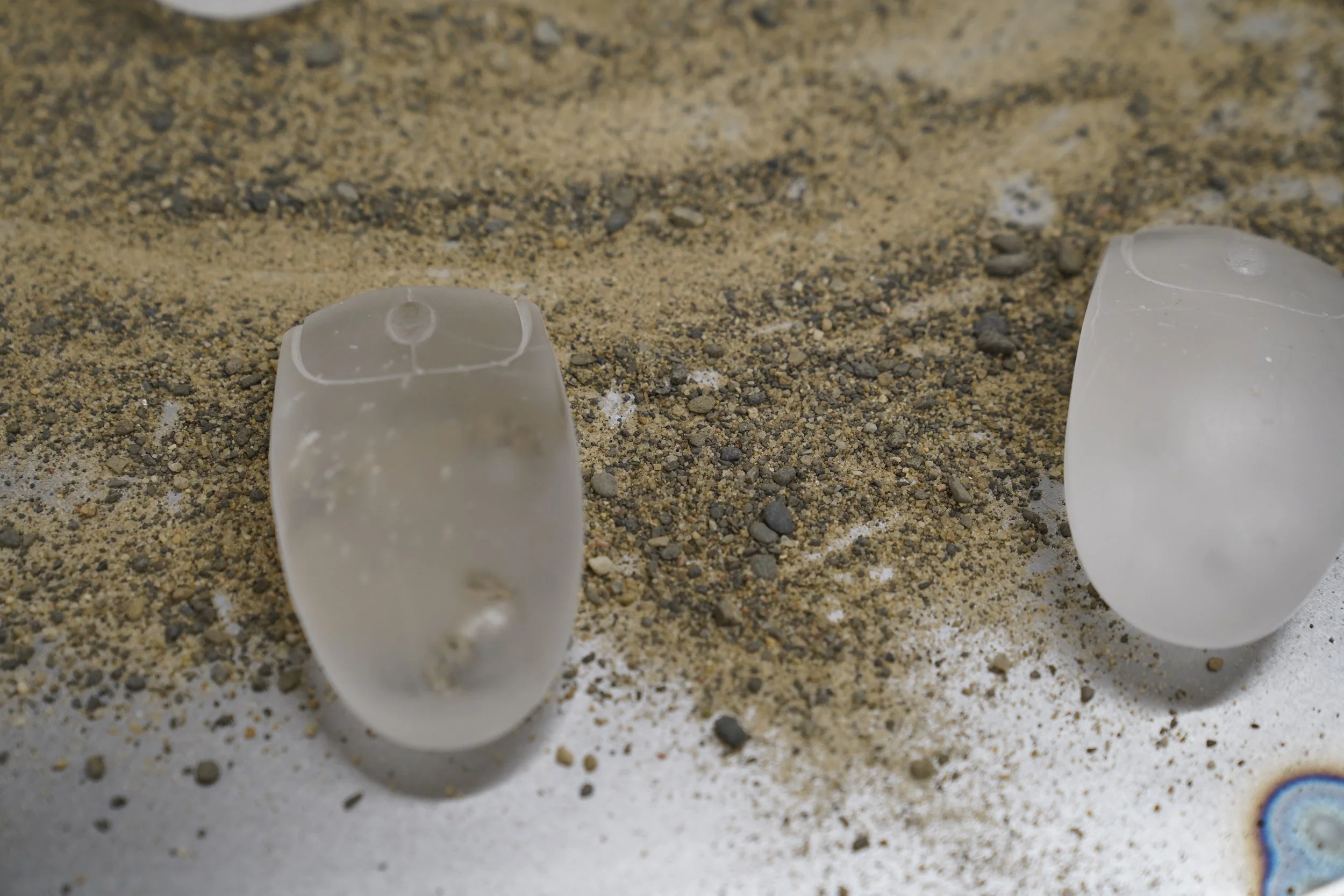
KC: I feel like I'm looking at this table filled with [computer] mice (one of Katie’s glass and metal in-progress sculptures) and I'm almost thinking about like some sort of like community, but they're kind of trapped in their own little world. But they're also like…
NH: Is that sand?
KC: Yeah.
NH: I feel like a lot of people know that glass is made from sand, and I'm wondering when you're making this piece, what were you thinking about? It’s got me wondering about our roots in community so far.
KC: Yeah, so this isn't done yet, but all these pieces that you're looking at here are towards this project; the working title of it right now is called Time Theft. I've been on this research rabbit hole about sabotage as labor resistance. And sabotage, I’m mostly interested in not how we closely use it, but more of the original definition of the word as defined by early socialist labor organizers to describe actions that you can take in a strike. Is it impossible, or is it working? It can describe a lot of things, from work slowdowns to malicious compliance and discreet property damage. But this show I'm working on is thinking about time theft by digital workers and drawing comparisons to the early Industrial Revolution, when people were protesting the commodification of time. So this project, I'm making a bunch of absurd sculptures that are sort of like analog mouse jigglers, and there's lots of thieves of computer mice and clocks, but with, you know, glass casting and metal structures. What you're looking at eventually will be a kinetic sculpture.
NH: Ooh. The mice are going to move around? That's so interesting. How are you going to do that? Are you going to attach something to the mice, or is it going to be underneath the table?
KC: It’ll have an arm on it like a clock. This herd of mice that's kind of being corralled in a circle, and then that will make it feel like a clock.
NH: You’ve answered most of my questions, but this certainly relates to the relationship between labor, unionism, and larger systems of power.
KC: For me, the material of ceramics, I feel like an atmospheric firing is more of that influence because you can't do it alone. It's impossible to do solo for the most part. It's usually a group of people put in a wood firing not too long ago, where you have to fuel the kiln for five plus days, over like every hour of the day. So, you're taking shifts, and the way that you're loading a kiln, the pots around yours will influence, like, what surface textures that you get on your pots…
NH: Other people's work is influencing yours and vice versa.
KC: Yeah, everyone's like, practicing working towards the goal and trusting each other to make decisions that are best of the group. I really like these communal making processes. Same with, like, this iron pour I did recently, where 20-plus artists were moving around molten hot metal to, like, put into these sand molds. It's almost like this industrial dance that everybody's doing together to make their work. And that's interesting to me too, because it's sort of like artists taking over the needs of a production factory. I guess the methods of making sculpture are also metaphorically interesting to me, as in practicing humans working together towards something bigger than themselves. Especially, at that kind of scale, because I feel like… it can be a very intimate thing too, when you're working at a medium-to-large scale, but if it's like this larger mass of material, I’m thinking about how much effort it takes to really produce that sort of transformation to create something else.
NH: I can see your through-line with this idea of transformation and material the way you're thinking about the working class. It translates and carries through in your work with community and working towards change.
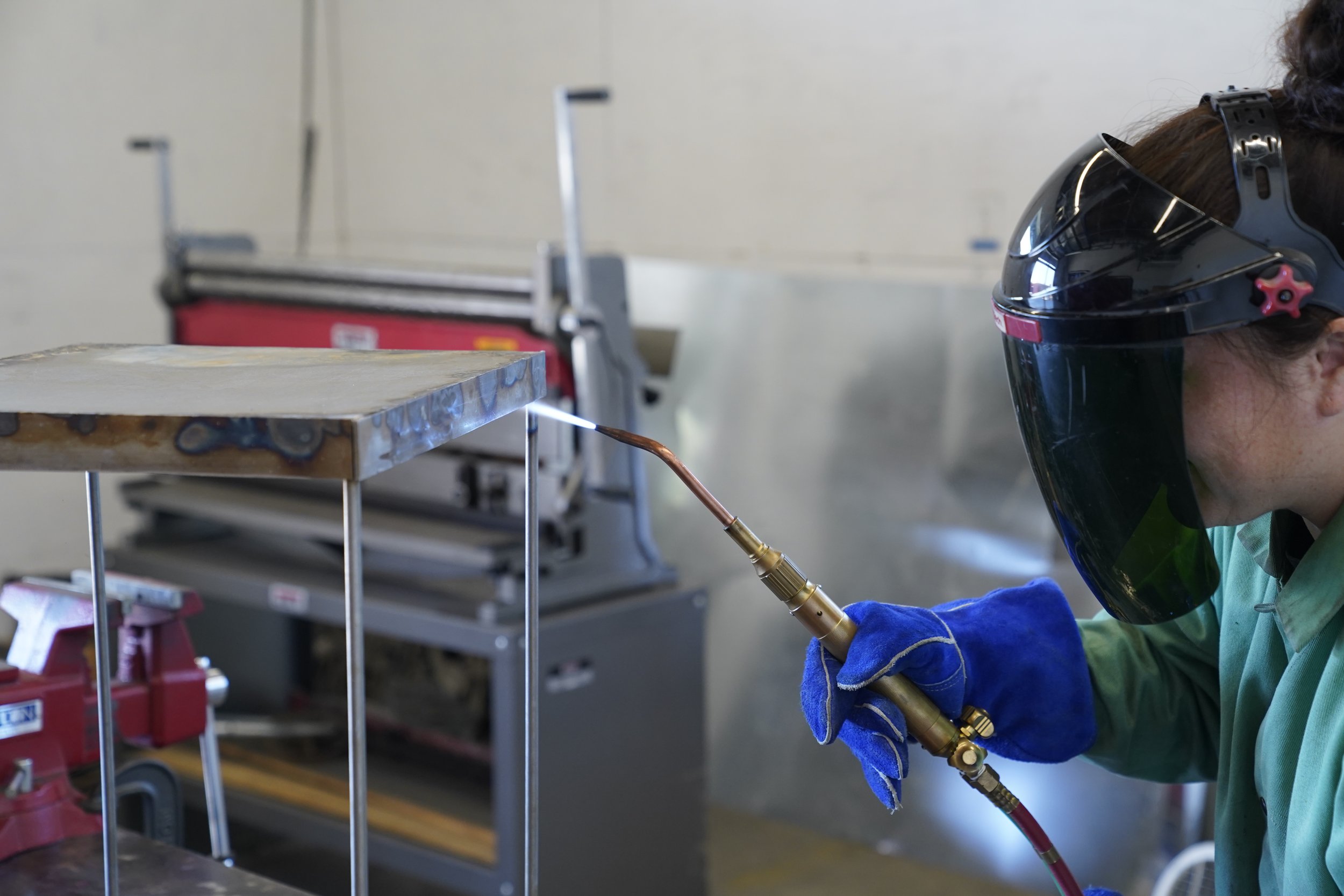
KC: When you came to do this interview, I was like hitting my head against this wall trying to figure out these marks. I think kind of what you were talking about here, like with how much effort it takes to make something. Some of these sculptures, like this table, and then that side table over there that I was working on, I'm making them to look like they are mass-produced objects, to look like something you would have gotten out of a factory somewhere. But I'm making it myself and like to get that precision. It's hard to do without industrial-scale equipment. However, I'm also trying to reveal the labor by leaving these weld marks behind so that there's, like, this trait and this evidence of, like, “oh, this is handmade, it's not factory-made.” I feel like in general I like objects that kind of play with that tension. Something that looks familiar, but then it’s a little strange and a little different. So by making this table look like something you would have gotten out of, I don't know, like a box when it’s not, and it looks kind of odd, I'm hoping that that could put the viewer in a mindset of, like, you know, some of the things that look like what reminds us of our reality, but they're different. Hopefully that can remind us that our world isn't as fixed as it could be and that it changes.
NH: Thank you!