
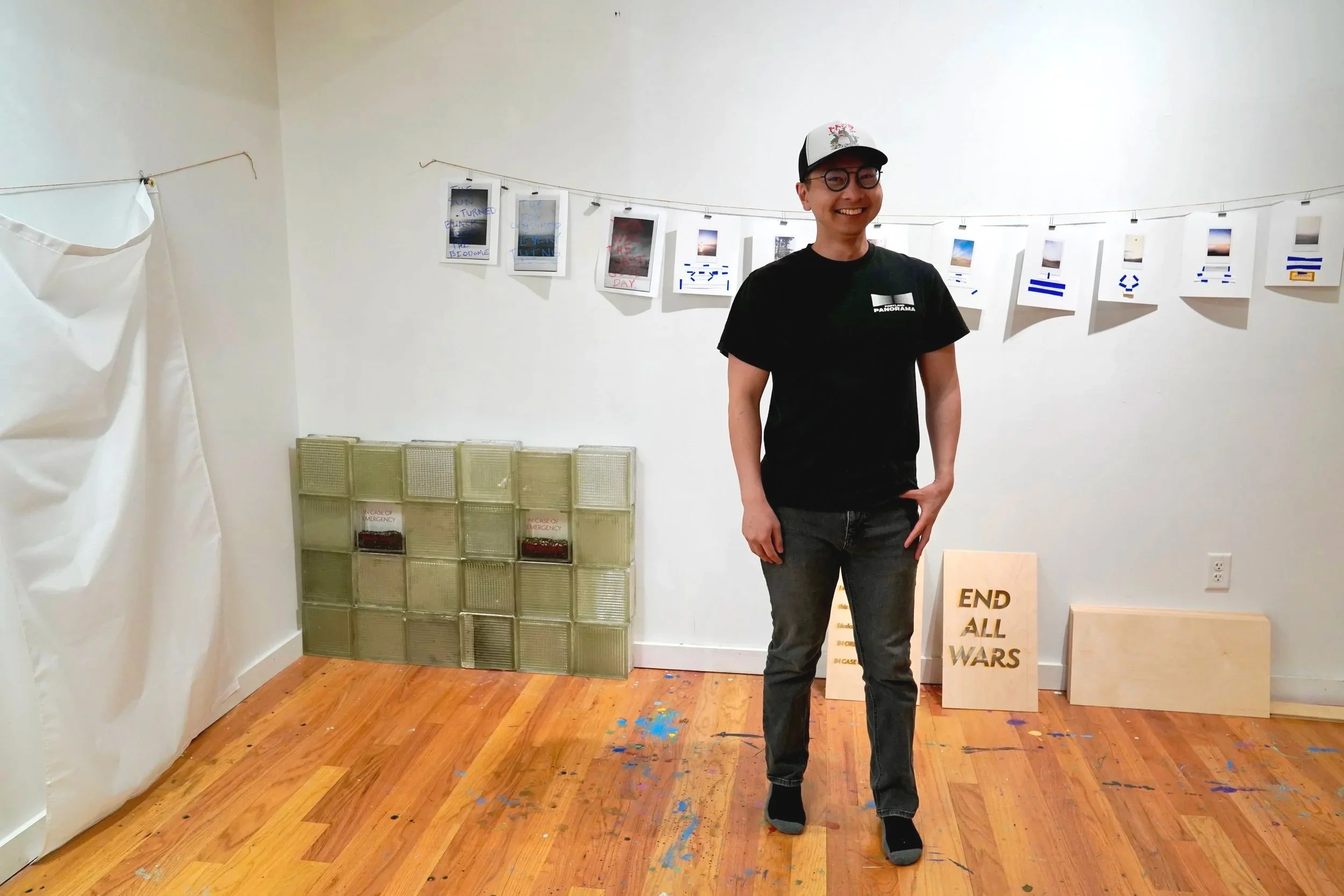
Savannah Brister, our Spring Intern, in conversation with March Resident, Takahiro Suzuki.
Takahiro Suzuki (he/him/his) is a Maine-based artist and educator. He completed his BA in Studio Art from the University of Virginia and received his MFA in Film, Video, Animation, and New Genres from the University of Wisconsin-Milwaukee. His work and research practices as an artist serve as a form of inquiry, in which the end product is an open-ended gesture or question for the audience to consider. Recent works have considered narratives surrounding non-human forms of intelligence and the connections, collaborations, and cohabitation that can arise when such beings are given agency. His works have been exhibited and screened nationally and internationally. Suzuki is currently an Assistant Professor of Art at Colby College and also serves as the co-founder and co-curator of aCinema, a collaboration with Janelle VanderKelen, which presents experimental film and video screenings at Woodland Pattern in Milwaukee, WI.
Savannah Brister: Tell me about yourself and your work.
Takahiro Suzuki: I typically work in film and video, but here I am working on some other projects. I am thinking about non-human forms of intelligence, as well as the climate crisis related to AI. One of the projects titled 2X84 takes inspiration from George Orwell’s 1984 and Haruki Murakami’s 1984 to think about dystopian versus actual realities. I am curious about AI’s perspectives and what it might think after humans disappear. In my writing from AI’s point of view I reference biodomes, alternate sky colors, and pulling from reference images and narratives that I had AI write through 2025. I am using a letter press to create narratives through one liners, with the goal of making a “choose your own adventure” story. This gives curators the ability to create narratives of their own choosing.
SB: What does your process look like? What are your main influences?
TS: A lot of my recent work starts with literature, like the two books mentioned above for 2X84. For the works about non-human intelligence, I’m inspired by work by Dr. Suzanne Simard and her research on Mother Trees and fungal networks and by James Bridle and his book Ways of Being. I’m also inspired by works of contemporary artists like Paul Pfeiffer, who explores kinds of sensationalism in his work. In the AI prompts mentioned above, I also asked ChatGPT to give me a carbon offset, so I’ll end up tallying that total and actually spending that much time off the internet. This sort of durational performance is inspired by Tehching (Sam) Hsieh, who did a series of year-long performance works. Since 2000, he hasn’t made art, but in a way the act of living is his performance.
SB: How do you want your work to exist in the world? How do you want people to interact with it?
TS: With film and video work, I typically screen those at film festivals and those short films are curated with works by other makers to create a longer program. When I’m able to attend the festivals, it’s always interesting to see how different curators/programmers build larger narratives with my work in conversation with others and how audiences engage with it.
Recently I’ve also been working on a bit more socially-engaged or participatory work. So the flags that you see are part of a long-term project called the tanabata project, where I had people anonymously send one wish on a postcard. The project is an homage to two Japanese artists, On Kawara and his “I Got Up” series and Yoko Ono’s Wish Tree. The wishes on the postcards I receive become prompts for me to create small gestures and art projects as a form of wish fulfillment.
During the pandemic, I also started something called the relative inconvenience store which is a play on our consumer culture and the establishment of the convenience store. I just remember images during lockdown of the air in Los Angeles clearing from all the smog and it made me wonder what sort of harm we’re doing to the environment for the convenience of consuming things at a moment’s notice. So the relative inconvenience store is something where if I have extra things in the studio, or find old works, or make new works specifically for the project in small quantities, I’ll list it in the store. The listings will be really inconsistent, and “stock” will always be really low, but all items will also be free. The idea of giving away the art is also because I want people to have access to art and be able to have works to display in their own personal spaces.
SB: Why do you make (what you make)?
TS: I am exploring different methods of storytelling, communicating, and speaking. I want to tell stories and share what I am thinking about. With my works, I’m not necessarily interested in creating something that’s didactic or has a definitive message. I want my work to exist as a consideration or question for both myself and the audience to consider together. So for the 2X84 works, I sort of leave it up to the audience to interpret — is it dark or hopeful?
The exception might be with the tanabata project works and especially the flag and prints which explicitly say “End All Wars.” This I think is a bit different because I’m responding to another person, whose wish was, “I wish all wars would be over,” and I have to create with the mindset of another person’s desires.