
KNOWLEDGE IS FOR CUTTING: QUEER COLLAGE TODAY
Curated by Rowan Buffington
March 5th - June 12th, 2027
Opening reception March 5th 6-8 pm
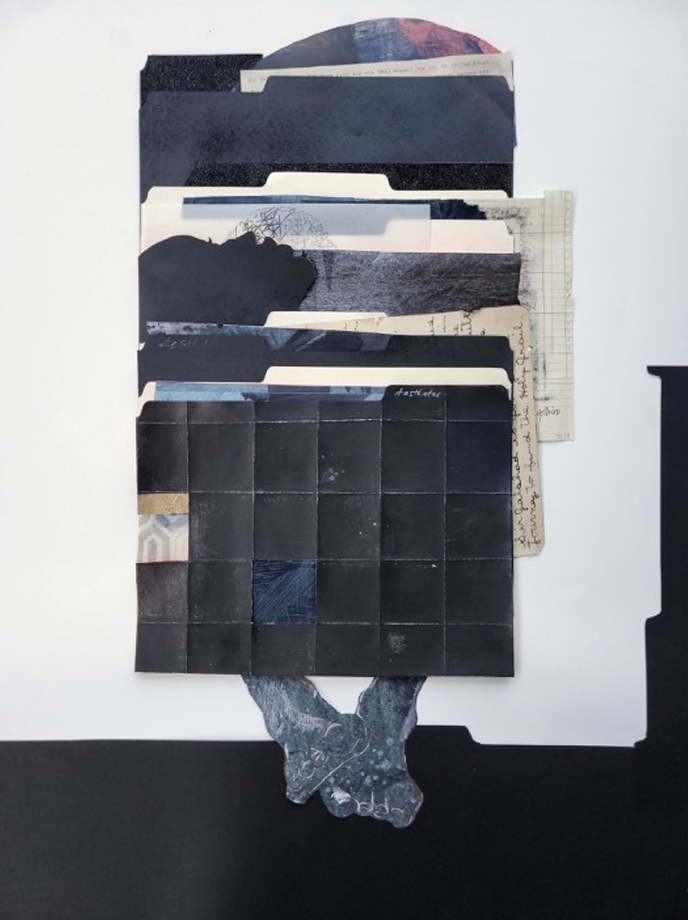
Lovie Olivia
Knowledge is for Cutting is an exhibition of 12 contemporary queer collagists whose practices explore the underside of knowledge production, a community of outcast thinkers who revive what Michel Foucault describes as “subjugated knowledges.” The exhibition title is also borrowed from Foucault, who reminds us that, while knowledge may serve power, it can also be used for “cutting”; that is, to interrogate dominant narratives, expose covert power structures, and promote new ways of being, thinking, making, and doing. Similarly, collage doesn’t cut paper so much as it severs, decontextualizes, recontextualizes, and remotivates cultural material; it is a way of intervening in the world.
In The Queer Art of Failure, Jack Halberstam advocates for antidisciplinary forms of knowing. "Terms like serious and rigorous," Halberstam points out, "tend to be code words...for disciplinary correctness; they signal a form of training and learning that confirms what is already known according to approved methods of knowing, but they do not allow for visionary insights or flights of fancy.” While it is evident that collage as a medium is beginning to emerge from the shadows of more historically dominant art forms, Halberstam would caution the collagist against tried-and-true paths to success: "Being taken seriously means missing out on the chance to be frivolous, promiscuous, and irrelevant" (Halberstam, 6).
Knowledge is for Cutting derives several creative models from Halberstam’s text, including: 1) the “silly archive”; 2) low theory; and 3) illegibility.
1) The “silly archive” stands in contrast to the official archives of the dominant knowledge and culture industries, the type of material housed within the library, the museum, and the special collection. Kirk Read’s prolific cut-and-paste practice incorporates a scrapheap of abandoned imagery appropriated from vintage children’s books, musty encyclopedias, outdated instruction manuals, and passé fashion magazines, the type of material one might discover in a discard bin.
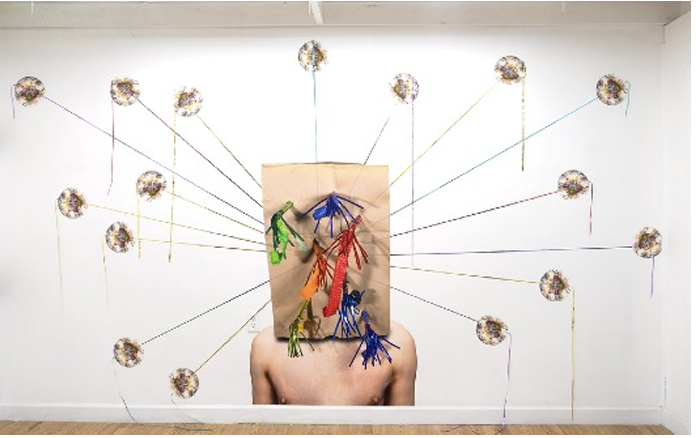
Dave Kube
2) Halberstam describes low theory as a theoretical model that “flies below the radar, that is assembled from eccentric texts…, that refuses to confirm the hierarchies of knowing”. Max Adrian’s anti-monuments resemble obelisks or totems. Yet rather than being made of a relatively permanent and semantically neutral material such as granite, they are comprised of a motley array of decidedly un-serious and fugitive materials: spandex, fake dynamite, orange peels, lint rollers, wind-up toys, solar eclipse glasses, etc. Adrian’s assemblages thus embrace what Halberstam characterizes as “the small, the inconsequential, the micro, the irrelevant”.
3) Halberstam points out that legibility is demanded by state power in the form of documenting, sorting, and organizing citizenry. This produces “subjects who are manipulated precisely when they become legible and visible to the state; undocumented workers, visible queers, racialized minorities”. It follows that illegibility constitutes a refusal of mastery. Vintage 1970s file folders serve as substrates for Lovie Olivia’s collages, which brim over with lab chronicles, found letters, and the artist’s own graphite drawings. Knowledge is shunted aside and shuffled here, misaligned, disorderly, “insufficiently elaborated”.
Halberstam concludes, we need “new rationales for knowledge production, different aesthetic standards for ordering and disordering space, other modes of political engagement than those conjured by the liberal imagination”. Collage dabbles in knowledge, tampers with politics, teases aesthetics, and Knowledge is for Cutting is itself a collage, assembling a far-flung contingent of fugitive knowers.
Participating Artists - TBA
About the Curator -
Rowan Buffington is a collagist based in Chattanooga, TN. They received their MFA from the College of Design, Architecture, Art, and Planning at the University of Cincinnati. Buffington’s work has been featured in numerous curated exhibitions, including: The Shadow’s Body: Painting’s Allegorical Impulse at Watkins College of Art, Nashville, TN; Book of Monsters at Ditch Projects, Eugene, OR; Aloe Vera at Gray Contemporary, Houston, TX; and Tennessee Abstract Painting at the Cheekwood Museum, Nashville, TN. Buffington has participated in residencies at: the Banff Centre for Arts and Creativity in Banff, Canada; Mudhouse in Agios Ioannis, Crete; SÍM in Reykjavík, Iceland; Vermont Studio Center in Johnson, VT; and Yaddo in Saratoga Springs, NY.